Before we plan for any assessment, it is important to go back to the learning objectives that we had determined for the students at the start of the topic or a course.
Most learning objectives are based on a learning progression framework like Bloom’s taxonomy or SOLO taxonomy.
For the purpose of this course, we are looking into Bloom’s Taxonomy and how it fits into the world of assessments.
Bloom’s Taxonomy is a classification of the different objectives and skills that instructors set for their learners (learning objectives). The taxonomy was proposed in 1956 by Benjamin Bloom, an educational psychologist at the University of Chicago.

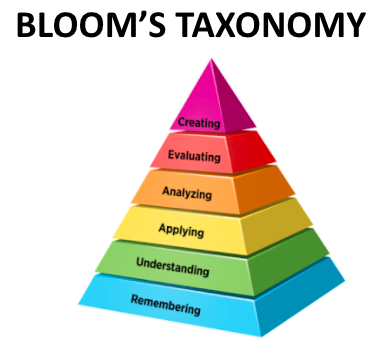
When we start a lesson on a topic or design a course, we first determine our learning objectives. These objectives are based on different cognitive skills across Bloom’s Taxonomy because it is important to test both the lower-order ( Remember, Understand) and higher-order skills ( Apply, Analyze, Evaluate, Create).
The following table shows some of the skills or verbs aligned with different cognitive levels of Bloom’s Taxonomy.
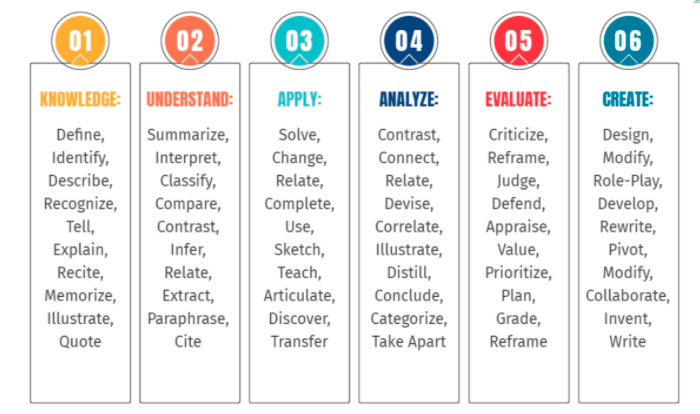
The learning objectives usually contain these verbs depending on the cognitive level that we wish the learner to attain in a topic. Click here to learn more about creating learning objectives using Bloom’s Taxonomy. This is a downloadable PDF that you can use for your reference in the future